
AOAC Method SMPR 2018.012 Instrumentation Guide
Standard Method Performance Requirements (SMPR) for Quantitation of Peanut by ELISA-Based Methods
AOAC SMPR 2018.012 defines the performance criteria for ELISA-based methods used to quantify peanut residues in raw and processed food products. These methods must detect total peanut protein, including in thermally processed or fermented matrices. The method requires a limit of quantitation (LOQ) of ≤ 1 mg/kg, with an analytical range that includes at least 10 mg/kg. It also requires recovery between 50% and 150%, repeatability (RSDr) ≤ 20%, and reproducibility (RSDR) ≤ 30%. Instrumentation must support absorbance-based ELISA workflows with strong linearity and precise thermal control.
ELISA microplate readers must measure absorbance at 450 nm and allow accurate quantitation across the validated working range. Incubators must maintain stable assay temperatures (typically 37 °C) with minimal fluctuation. The systems listed below support these requirements and enable validated peanut detection workflows using commercial or in-house ELISA kits. They support AOAC SMPR 2018.012 performance criteria and are well suited for use in food safety and allergen control laboratories.
Please click here to learn more about AOAC Method SMPR 2018.012
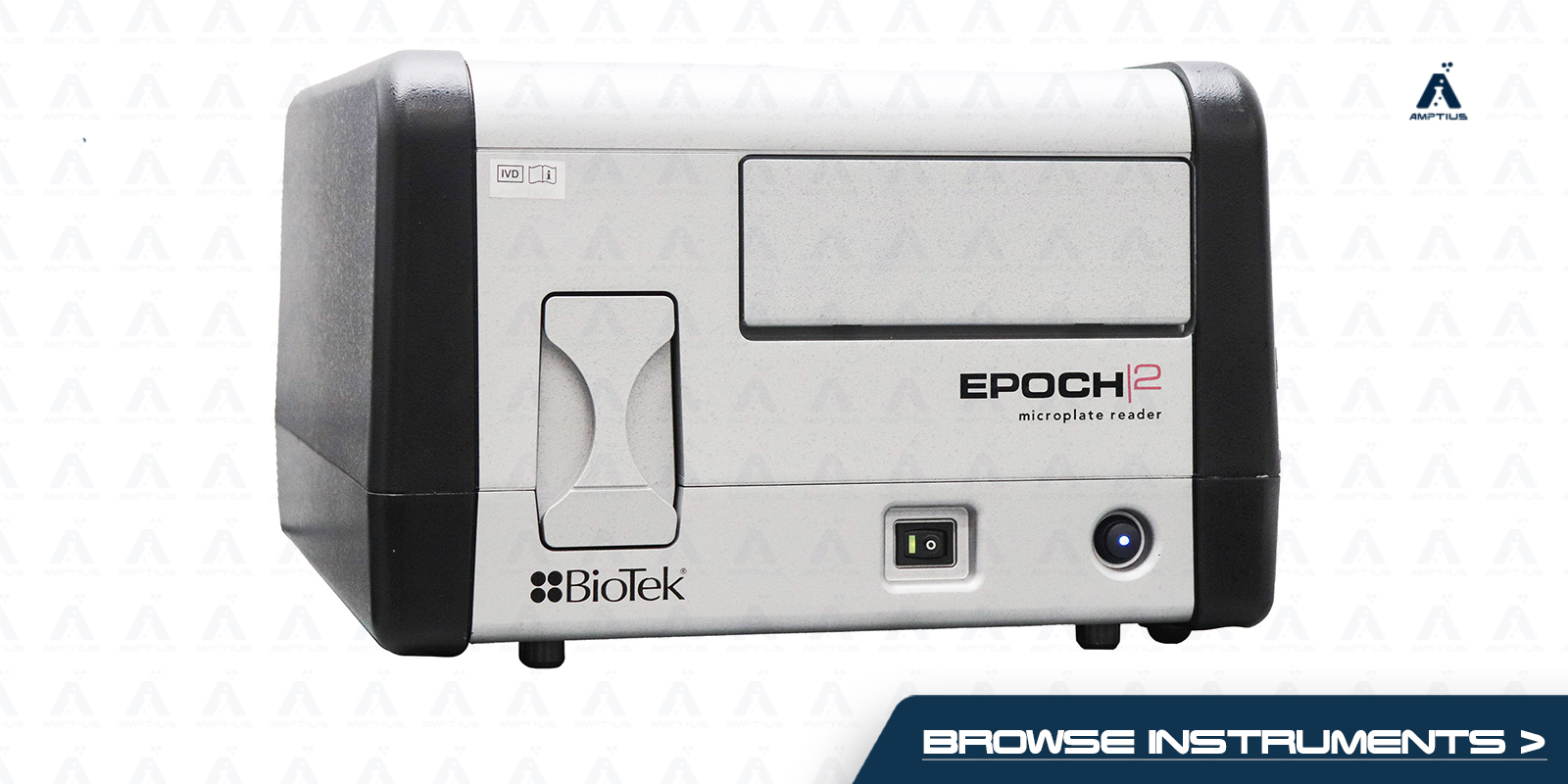
BioTek EPOCH 2 EPOCH2TSC Microplate Reader with Gen 5 Software for AOAC Method SMPR 2018.012
The BioTek EPOCH 2 Microplate Reader is optimized for ELISA absorbance detection and meets core expectations outlined in SMPR 2018.012. It supports endpoint measurements at 450 nm, the standard wavelength for peanut ELISA assays. Gen5 software provides powerful curve-fitting tools, supporting quantitation with linearity (r ≥ 0.95) and compliance-ready reporting. The integrated incubation and shaking capabilities help enhance reaction consistency and signal uniformity. It is a trusted choice in regulated food allergen testing workflows.
With reliable temperature control and spectral accuracy, the EPOCH 2 delivers repeatable results even across complex or heat-processed matrices. Users can automate plate reads, monitor standard recovery, and export calibration curves for review. Its design is well suited for labs prioritizing speed, accuracy, and regulatory compliance. This system supports validated workflows aligned with SMPR peanut quantitation criteria.
Tecan Infinite M Nano+ Multimode Plate Reader for AOAC Method SMPR 2018.012
The Tecan Infinite M Nano+ is a compact multimode plate reader with robust absorbance detection at 450 nm, making it ideal for ELISA-based peanut quantitation. It supports the performance expectations of AOAC SMPR 2018.012 by delivering strong signal stability and high sensitivity across 96-well plate formats. Its user-friendly software enables linear regression analysis and routine method validation. The platform’s optical precision supports reproducibility and accuracy in allergen testing. It is suitable for both research and quality control labs.
With its reliable hardware and flexible software options, the Infinite M Nano+ is effective for quantifying trace peanut protein in raw or processed foods. It supports easy integration with validated ELISA kits and can accommodate high-throughput workflows. Its compatibility with SMPR-aligned protocols makes it a dependable solution for routine allergen detection. This system is a versatile asset in food allergen testing programs.
Thermo Scientific Multiskan SkyHigh Microplate Spectrophotometer for AOAC Method SMPR 2018.012
The Multiskan SkyHigh from Thermo Scientific is a purpose-built ELISA plate reader with precise 450 nm absorbance capabilities. It features a large touchscreen interface and supports full-plate reads with high optical resolution. The system meets AOAC SMPR 2018.012 performance expectations for quantitation, repeatability, and linearity. Its incubation and shaking options enhance assay consistency and minimize variation between wells. Data can be stored onboard or exported for regulatory documentation and reporting.
Designed for regulated environments, the SkyHigh is compatible with commercial peanut ELISA kits and supports custom assay workflows. It simplifies data acquisition while delivering consistent analytical results. Labs benefit from its robust performance and intuitive software features. Whether analyzing processed foods or raw ingredients, this reader offers the performance required for accurate peanut quantitation. It is a strong fit for compliance-focused laboratories.
BMG LABTECH SPECTROstar Nano for AOAC Method SMPR 2018.012
The SPECTROstar Nano by BMG LABTECH offers full-spectrum absorbance from 220–1000 nm, making it highly adaptable for ELISA applications. It supports single and multi-wavelength endpoint reads, including at 450 nm. Its high photometric accuracy and reproducibility meet SMPR 2018.012 performance criteria, including low-level peanut detection and quantitation. The system integrates with method validation tools to assess recovery, linearity, and signal stability. Its versatility supports peanut ELISA testing in a range of food matrices.
The system’s compact footprint and quick-read technology improve efficiency without compromising accuracy. Analysts can validate assay linearity and perform trace analysis with ease. Its flexibility makes it suitable for both research and regulated testing workflows. SPECTROstar Nano is a proven platform for food allergen quantitation and method standardization. It ensures consistent alignment with SMPR requirements.
Molecular Devices SpectraMax ABS Plus for AOAC Method SMPR 2018.012
The SpectraMax ABS Plus is a high-performance ELISA plate reader developed by Molecular Devices for quantitative absorbance assays. It supports 450 nm detection and includes SoftMax Pro software, which simplifies calibration, regression analysis, and recovery tracking. This reader supports AOAC SMPR 2018.012 performance criteria for quantitating peanut in a wide range of food products. Its robust optics and flexible plate formats support reliable ELISA signal acquisition. It is commonly used in food and environmental testing labs.
With precise temperature control and reliable optical consistency, the SpectraMax ABS Plus supports trace-level detection with high confidence. Its automated features help streamline validation and standard curve generation. Whether analyzing raw, cooked, or fermented foods, this system delivers accurate, reproducible quantitation. It’s a trusted tool in allergen control workflows and method validation studies.
Microbiological Incubator Thermo Fisher Isotemp Gravity Convection Stainless Steel 180L for AOAC Method SMPR 2018.012
The Thermo Fisher Isotemp Gravity Convection Incubator provides stable temperature control at 37 °C, which is essential for peanut ELISA workflows. Its 180-liter stainless steel chamber supports batch incubation of multiple 96-well plates. Gravity convection ensures uniform heat distribution without forced air that could cause evaporation. This incubator supports SMPR 2018.012 performance expectations for maintaining consistent assay conditions. It is widely used in labs performing food allergen testing.
Its simplicity and reliability make it a dependable choice for routine ELISA incubation. The stainless-steel interior supports easy cleaning and contamination prevention. With tight thermal uniformity, it maintains consistent assay kinetics across plates. This incubator supports robust and repeatable peanut ELISA workflows. It pairs well with all readers listed in this guide.
Benchmark SureTemp Digital Incubator for AOAC Method SMPR 2018.012
The Benchmark SureTemp Digital Incubator offers precise digital control for maintaining 37 °C incubation, which is critical for ELISA performance. It features a compact design with reliable temperature stability and uniformity. This incubator supports the thermal consistency required by SMPR 2018.012. Its programmable interface allows users to set and monitor assay conditions over extended incubation periods. It is well-suited for small-to-mid-scale ELISA testing operations.
SureTemp incubators support consistent plate processing for allergen detection workflows. Their accuracy enhances assay reproducibility and improves standard curve alignment. Whether used with manual or automated ELISA setups, they help labs meet SMPR incubation criteria. The system ensures performance integrity across peanut testing batches. It’s a reliable choice for food safety labs.
Memmert IN Series Laboratory Incubator for AOAC Method SMPR 2018.012
The Memmert IN Series Incubator delivers precise temperature control using natural convection, ideal for ELISA incubation at 37 °C. Its internal temperature stability ensures uniform assay conditions across all plates. With temperature fluctuation typically within ±0.5 °C, it supports SMPR 2018.012 expectations. The system’s design prevents sample evaporation and supports contamination-free operation. It is commonly used in food analysis and diagnostic laboratories.
The IN Series supports high-throughput plate incubation and batch reproducibility. Its quiet operation and high thermal uniformity support routine allergen analysis. For peanut ELISA methods, it enhances the consistency of color development and optical density. Labs value its build quality and long-term thermal reliability. It integrates smoothly into validated ELISA workflows.
Binder BD Series Incubator for AOAC Method SMPR 2018.012
The Binder BD Series Incubator is engineered for microbiological and ELISA applications requiring gentle heat distribution. Its gravity convection design supports stable 37 °C incubation across multiple microplates. This incubator maintains consistent temperature conditions with low fluctuation, supporting reproducibility in allergen detection assays. It supports the thermal requirements of SMPR 2018.012 for peanut ELISA incubation. Binder’s precision makes it a trusted option in regulated environments.
This unit offers reliable control of sensitive enzymatic reactions typical of peanut ELISA assays. It is frequently used in food safety and life science applications where consistency is critical. With its robust chamber construction and quiet operation, it enhances long-term reliability. The BD Series incubator supports method validation and standardization across multiple food matrices. It is an excellent match for SMPR-compliant ELISA systems.
Choosing the Right ELISA Instruments for AOAC SMPR 2018.012
- High-performance microplate readers: BioTek EPOCH 2, Thermo Multiskan SkyHigh, and SpectraMax ABS Plus
- Flexible multimode systems: Tecan Infinite M Nano+ and BMG LABTECH SPECTROstar Nano
- Precise incubation solutions: Thermo Fisher Isotemp, Benchmark SureTemp, Memmert IN Series, and Binder BD Series
AOAC SMPR 2018.012 requires validated ELISA platforms capable of detecting peanut protein at trace levels with strong linearity, accuracy, and temperature control. The systems listed above support these standards, making them ideal for food allergen testing and compliance workflows. Contact us today to learn more about certified refurbished ELISA systems that meet AOAC peanut quantitation requirements.