
AOAC Method SMPR 2017.018 Instrumentation Guide
Standard Method Performance Requirements (SMPR) for Determination of Free Bisphenol A (BPA) in Beverages
AOAC SMPR 2017.018 outlines the criteria for quantifying free Bisphenol A (BPA) in ready-to-consume, commercially packaged beverages. This includes carbonated and noncarbonated waters, juices, dairy-based drinks, and other non-alcoholic beverages. The method requires a limit of quantitation (LOQ) of ≤ 0.5 µg/L and a limit of detection (LOD) of ≤ 0.1 µg/L. Accuracy must range from 60–140% for concentrations below 2 µg/L and 80–120% for levels between 2 and 20 µg/L. Repeatability (RSDr) and reproducibility (RSDR) thresholds are defined based on BPA concentration and must be validated across different product types to ensure regulatory compliance.
To meet these requirements, laboratories must use LC-MS/MS systems equipped with triple quadrupole analyzers operating in ESI+ mode and MRM acquisition. These systems should also demonstrate strong matrix tolerance, precise retention times, and minimal background interference. Each platform must support trace-level quantification across diverse beverage matrices. Laboratories are responsible for validating performance according to the AOAC SMPR, ensuring accuracy and repeatability are maintained. The instruments listed below fulfill these criteria and are widely used in beverage BPA testing.
Please click here to learn more about AOAC Method SMPR 2017.018
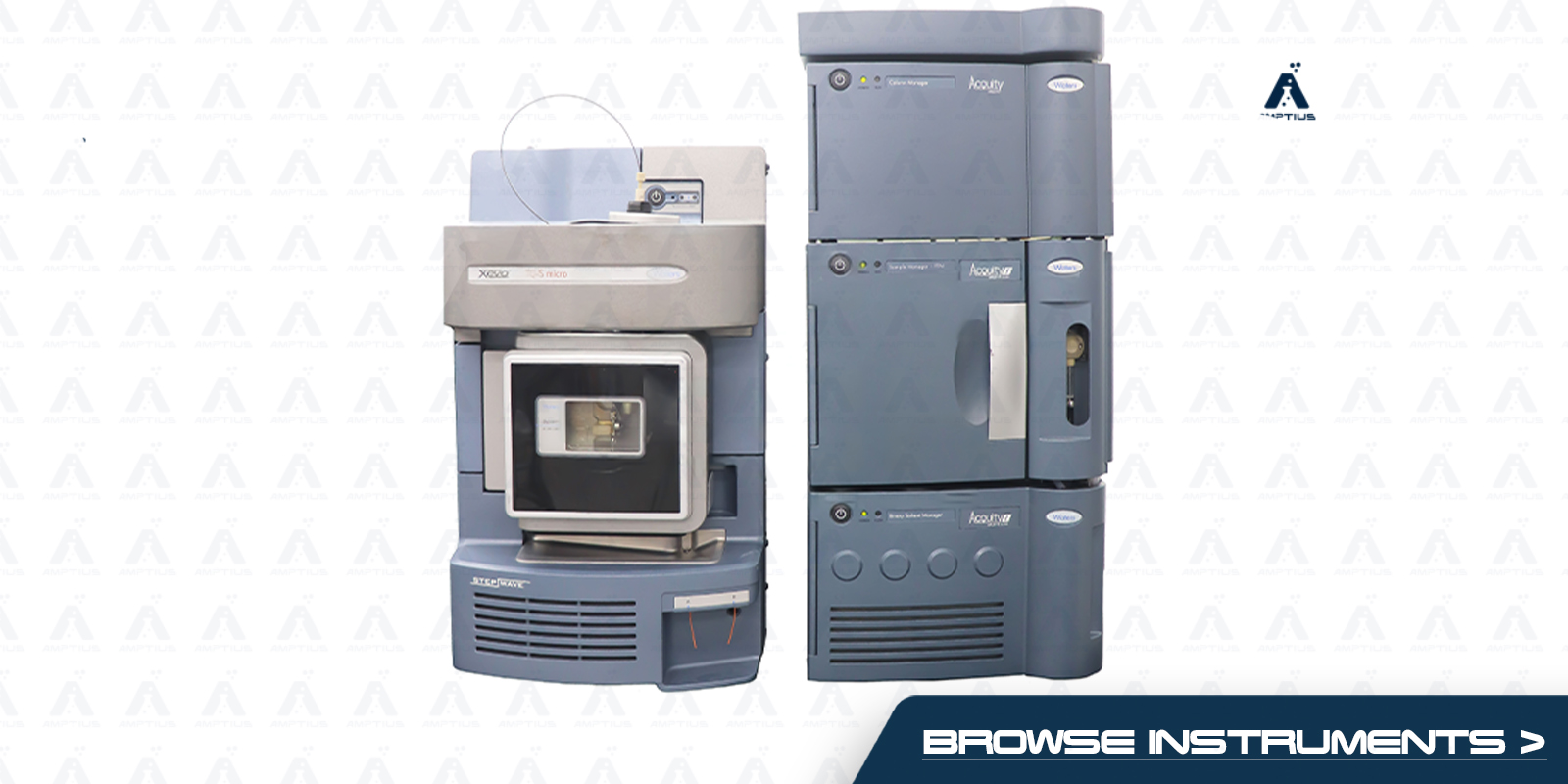
Waters Xevo TQ-S Micro Triple Quadrupole LC-MS/MS with ACQUITY I Class for AOAC Method SMPR 2017.018
The Waters Xevo TQ-S Micro, paired with the ACQUITY I Class UPLC, provides high sensitivity and rapid analysis for BPA quantification in beverages. StepWave ion optics improve ion transfer efficiency and reduce background interference, enhancing low-level signal quality. The UPLC front end delivers fast and reproducible gradients, supporting consistent separation across complex matrices. Accurate BPA detection depends on minimizing chemical noise and maintaining sharp peak resolution. This system is ideal for analytical labs focused on high-throughput compliance testing.
MassLynx software supports complete method development, batch reporting, and system suitability tracking. The software also facilitates validation by automating calibration curves and internal QC checks. When configured correctly, the system maintains LOQ and RSDR specifications consistently over time. Analysts benefit from stable signal acquisition, easy-to-use interfaces, and secure data archiving. This instrument is a proven solution for regulated beverage testing.
Agilent Ultivo Triple Quad LC-MS/MS System with 1260 Infinity II for AOAC Method SMPR 2017.018
The Agilent Ultivo Triple Quad LC-MS/MS system, combined with the 1260 Infinity II UHPLC, offers a compact and high-performance solution for BPA testing in beverages. Jet Stream ionization improves sensitivity and ionization efficiency, which helps laboratories detect BPA at sub-µg/L concentrations. The UHPLC delivers reliable retention time stability and excellent separation of BPA from other matrix components. This is critical for quantifying BPA accurately, especially in sugar- or fat-rich beverages. The Ultivo system is frequently used in labs that need precise results with a small footprint.
MassHunter software enables automated calibration, QA/QC tracking, and simplified reporting. It also supports regulatory compliance by offering traceable documentation for audit readiness. Analysts appreciate its intuitive design and minimal training requirements. With robust peak shape and signal linearity, this system meets AOAC Method SMPR 2017.018 standards. Consistent validation ensures long-term reliability and reproducibility.
Thermo Scientific TSQ Altis Plus with Vanquish UHPLC for AOAC Method SMPR 2017.018
The TSQ Altis Plus from Thermo Scientific, when combined with Vanquish UHPLC, provides robust detection of BPA at trace levels. Active Ion Management technology ensures signal stability and increases MRM transition efficiency. Rapid polarity switching helps capture analytes with greater precision across complex beverage matrices. The Vanquish UHPLC system offers sharp peak definition and low carryover, making it ideal for routine testing. This system is particularly suited for detecting BPA in beverages with challenging background noise.
TraceFinder software supports calibration, system suitability, and regulatory documentation. Analysts benefit from streamlined data processing and secure compliance-ready reporting. High-throughput labs appreciate the system’s durability and consistent signal performance. With proper internal validation, this platform reliably meets AOAC SMPR 2017.018 criteria. Its versatility and proven performance make it a go-to choice for BPA quantitation.
Shimadzu LCMS-8060NX with Nexera X3 UHPLC for AOAC Method SMPR 2017.018
The Shimadzu LCMS-8060NX, combined with the Nexera X3 UHPLC, provides rapid and accurate BPA quantification in complex beverage matrices. This system offers ultra-fast MRM acquisition and high-sensitivity detection for trace-level contaminants. Enhanced desolvation technology minimizes background noise, improving reproducibility. Strong chromatographic resolution allows laboratories to separate BPA cleanly from coeluting compounds. Together, these features support robust method performance across various sample types.
LabSolutions software streamlines method setup, calibration, and batch review. It also offers system suitability testing and report generation for regulatory workflows. The LCMS-8060NX system meets all key AOAC performance metrics when validated internally. Analysts can rely on this platform for dependable results, even in matrix-heavy beverages. It’s widely used in global food safety labs for trace contaminant monitoring.
SCIEX Triple Quad™ 6500+ LC-MS/MS with ExionLC AD for AOAC Method SMPR 2017.018
The SCIEX Triple Quad 6500+, with the ExionLC AD UHPLC, offers exceptional trace detection and repeatability for BPA analysis. Turbo V ionization technology provides stable ionization for improved quantitation. Scheduled MRM Pro ensures optimal transition timing, enabling high-throughput testing without loss of sensitivity. These features help labs detect BPA well below the SMPR-specified LOQ. The system performs well even with carbonated or protein-rich beverages.
SCIEX OS software provides complete traceability, method automation, and batch validation tools. Analysts can set up custom workflows that include automated checks for calibration and retention time stability. The system excels in reproducibility, helping laboratories maintain compliance across sample types. With proper method optimization, this platform achieves excellent accuracy and precision. It remains a trusted solution for environmental and food contaminant analysis.
Choosing the Right Instrument for AOAC Method SMPR 2017.018
- High-sensitivity LC-MS/MS platforms: SCIEX 6500+, Shimadzu LCMS-8060NX, and Thermo TSQ Altis Plus
- Compact, efficient solutions: Agilent Ultivo and Waters Xevo TQ-S Micro for space-limited labs
- High-throughput beverage workflows: SCIEX, Shimadzu, and Thermo systems validated for regulatory trace-level detection
AOAC SMPR 2017.018 sets strict performance targets for BPA detection in packaged beverages. These include sub-µg/L LOQ thresholds and tight reproducibility ranges across diverse beverage types. Laboratories must select systems that consistently meet these performance expectations through validated workflows. The instruments featured here offer the sensitivity, matrix tolerance, and operational reliability needed for regulatory testing. Contact us today to explore certified refurbished systems tailored to AOAC-compliant workflows.