
AOAC Method SMPR 2016.007 Instrumentation Guide
Standard Method Performance Requirements (SMPR) for Detection of Francisella tularensis in Aerosol Collection Devices
AOAC SMPR 2016.007 establishes method performance requirements for nucleic acid-based detection of Francisella tularensis using aerosol collection devices. The method must achieve an Acceptable Minimum Detection Level (AMDL) of 2,000 genomic equivalents per milliliter in sample collection buffer. At this concentration, the system must demonstrate a Probability of Detection (POD) of at least 95 percent. The system false-negative rate must be no greater than 5 percent, and the false-positive rate must also not exceed 5 percent when tested using environmental matrix materials. The maximum allowable time-to-result is four hours from sample collection to final result.
To meet inclusivity requirements, the method must detect all 15 designated inclusivity strains of Francisella tularensis at two times the AMDL, or 4,000 genomic equivalents per milliliter. For exclusivity, the method must not produce positive results for any of the 29 exclusivity organisms when tested at ten times the AMDL, or 20,000 genomic equivalents per milliliter. Instruments must also demonstrate stable performance across aerosol matrices and varying environmental conditions. Reliable amplification, assay reproducibility, and strong discrimination between true positives and false positives are critical. The platforms listed below support these requirements when configured with validated workflows and appropriate quality control procedures.
Please click here to learn more about AOAC Method SMPR 2016.007
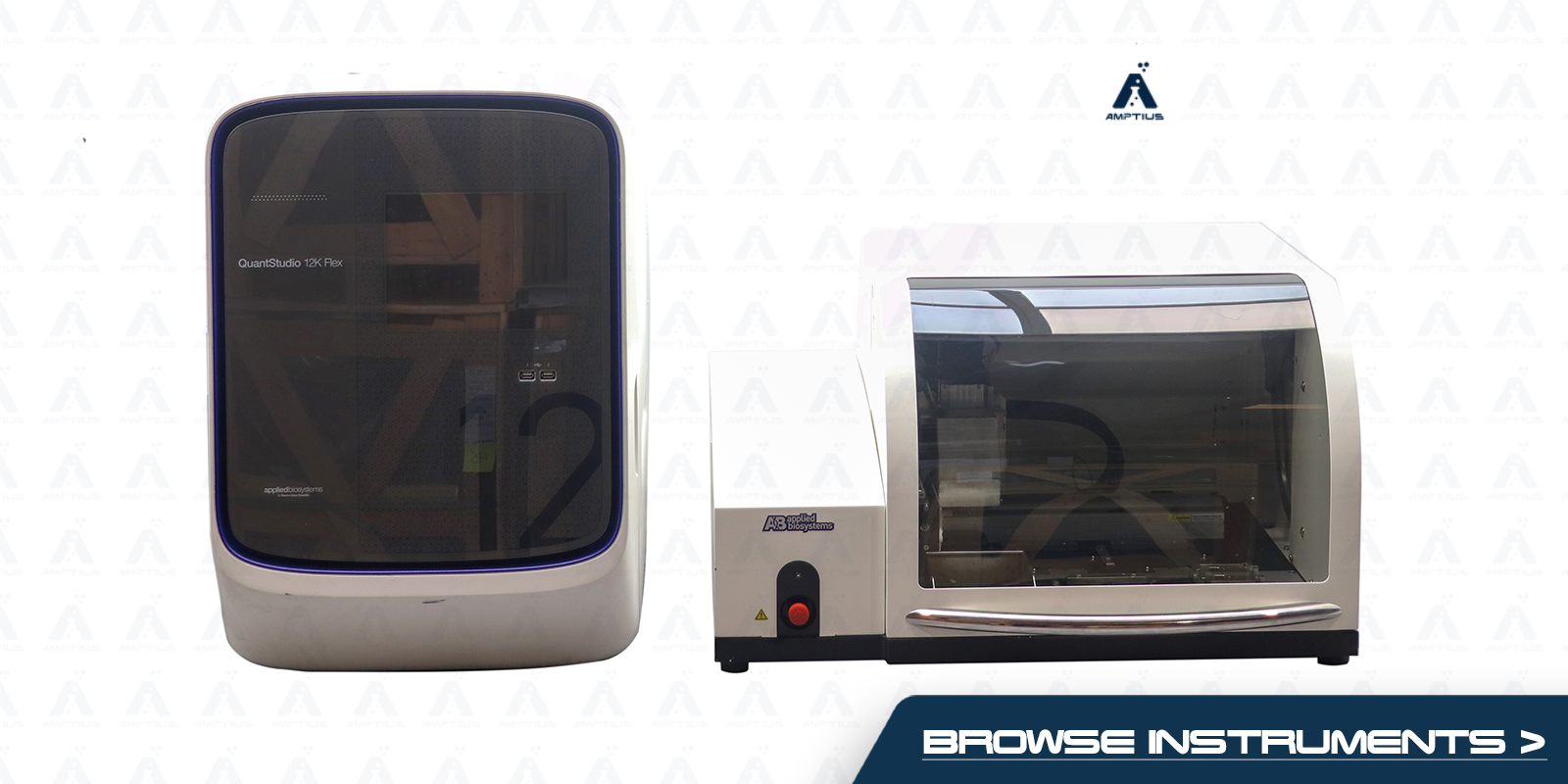
QuantStudio 12k Flex Real-Time OpenArray qPCR with AccuFill for AOAC Method SMPR 2016.007
The QuantStudio 12k Flex Real-Time PCR System with OpenArray and AccuFill automation offers high-throughput, sensitive detection of target DNA sequences. Its modular design supports multiple formats and enables simultaneous detection of numerous targets. When paired with validated qPCR assays for Francisella tularensis, it meets the AMDL and POD criteria while maintaining reproducibility across diverse sample types. Its optical detection system and liquid handling precision make it a reliable tool for aerosol sample testing. This platform is ideal for large-scale testing operations in reference laboratories and public health settings.
The QuantStudio 12k Flex is compatible with assay formats that support validated inclusivity and exclusivity performance. The AccuFill system reduces pipetting errors and increases assay precision during plate setup. Its intuitive software interface allows for automated calibration, traceable data logging, and comprehensive system checks. These features enhance compliance with SMPR 2016.007 and ensure consistent detection across varied conditions. The system is well-suited for high-throughput surveillance and regulatory applications where reliability and reproducibility are essential.
BioFire Diagnostics FilmArray Torch PCR System (2 Modules) for AOAC Method SMPR 2016.007
The BioFire FilmArray Torch PCR System with two modules provides a fully integrated, sample-to-answer solution for detecting Francisella tularensis. Its closed-cartridge design automates extraction, amplification, and detection, minimizing operator error and contamination risk. The system delivers results in under one hour, well within the four-hour time requirement defined in SMPR 2016.007. BioFire panels are developed with validated inclusivity and exclusivity performance to support compliance. Its ease of use and low hands-on time make it ideal for time-critical or field-based testing environments.
System software automatically tracks run data, performs internal controls, and generates audit-ready reports for regulatory use. When combined with aerosol collection methods, the platform offers reliable performance in diverse testing matrices. Its compact footprint allows deployment in mobile units, emergency response vehicles, or fixed laboratories. The FilmArray Torch’s cartridge-based operation simplifies training and minimizes setup complexity. For laboratories that require rapid and consistent pathogen detection, it offers a robust and compliant solution.
Applied Biosystems ABI 7500 Fast DX Real-Time PCR System for AOAC Method SMPR 2016.007
The Applied Biosystems ABI 7500 Fast DX Real-Time PCR System is a widely accepted platform for regulated diagnostic workflows. It offers high-speed cycling and fluorescence detection to accurately quantify Francisella tularensis DNA at or below the required 2,000 genomic equivalents per milliliter. The system supports multiplex assays and delivers reproducible results, helping laboratories meet POD, AMDL, and time-to-result requirements. It is compatible with both custom and commercial assays designed for validated inclusivity and exclusivity testing. This system has been implemented in various biosafety and clinical laboratories for its reliability.
The 7500 Fast DX includes SDS software that supports data integrity, assay validation, and report generation. Its built-in system checks and calibration tools ensure performance consistency over time. With FDA 510(k) clearance, it is suitable for high-consequence pathogen detection in public health and biodefense settings. The system enables rapid adaptation to new assay panels as detection needs evolve. When integrated into a validated workflow, the 7500 Fast DX meets all performance criteria of AOAC SMPR 2016.007.
Applied Biosystems ABI ViiA 7 Real-Time PCR System (96-Well) for AOAC Method SMPR 2016.007
The Applied Biosystems ABI ViiA 7 Real-Time PCR System offers precise, high-throughput detection in a 96-well format, supporting both fast and standard cycling modes. It is engineered for robust quantification of Francisella tularensis across varied matrices, including aerosol extracts. Its advanced optics and uniform thermal control ensure minimal well-to-well variability, supporting reproducible assay performance. When used with validated assays, the ViiA 7 system can meet the inclusivity and exclusivity requirements for SMPR 2016.007. Its performance aligns with AOAC criteria for sensitivity, specificity, and time-to-result.
ViiA 7 software includes tools for method validation, calibration tracking, and automated result reporting. The platform supports multiplex assay development for efficient use of consumables and faster throughput. Laboratories benefit from the flexibility of user-defined protocols and compatibility with environmental testing workflows. It is widely used in research and applied testing laboratories for its reliability and scalable design. This system is a strong choice for labs conducting routine or emergency surveillance under AOAC guidelines.
Choosing the Right Instrument for AOAC Method SMPR 2016.007
- Top high-throughput qPCR platform: QuantStudio 12k Flex with OpenArray for multiplex capability and automated sample setup
- Field-deployable system: BioFire FilmArray Torch with rapid sample-to-answer integration and validated inclusivity/exclusivity performance
- Regulatory-approved solution: ABI 7500 Fast DX for proven, validated detection with robust documentation support
- Flexible lab-based platform: ABI ViiA 7 96-Well Real-Time PCR for consistent high-throughput testing across sample types
AOAC SMPR 2016.007 demands rapid, accurate, and specific molecular detection of Francisella tularensis with full validation for inclusivity and exclusivity. Laboratories must use platforms that support high POD at low target concentrations, minimal false-positive rates, and validated performance in real-world matrices. The instruments listed above satisfy these criteria when configured with approved assays and aerosol collection methods. Whether your application is for military readiness, public health, or environmental monitoring, selecting the right instrument is essential for compliance and confidence in results. Contact us today to learn how our certified refurbished PCR systems can help your lab meet AOAC standards while reducing equipment costs.