
AOAC Method SMPR 2016.002 Instrumentation Guide
Standard Method Performance Requirements (SMPR) for Detection and Quantitation of Selected Food Allergens
AOAC SMPR 2016.002 establishes performance requirements for detecting and quantifying selected food allergens, including whole egg, milk, peanut, and hazelnut, in food ingredients and finished products. The standard focuses on the active allergenic proteins and requires sensitive methods capable of distinguishing these allergens in complex food matrices. Mass spectrometry-based methods are recommended, with required method detection limits (MDL) of ≤ 1.65–3 ppm and method quantitation limits (MQL) of ≤ 5–10 ppm, depending on the allergen. Accuracy must fall within 60–120%, with repeatability (RSDr) ≤ 20% and reproducibility (RSDR) ≤ 30%. These performance criteria support laboratories conducting routine food allergen testing while maintaining full cGMP compliance.
Instrumentation must demonstrate adequate sensitivity, reproducibility, and specificity across different food matrices. Methods should accurately detect allergenic proteins and peptides at trace levels while minimizing cross-reactivity or matrix interference. Internal validation, proper sample preparation, and analyte stability play essential roles in achieving method performance targets. The systems listed below deliver reliable results in routine and high-throughput lab settings. When configured with validated protocols, these LC-MS/MS platforms fully support AOAC SMPR 2016.002 compliance for allergen detection.
Please click here to learn more about AOAC Method SMPR 2016.002
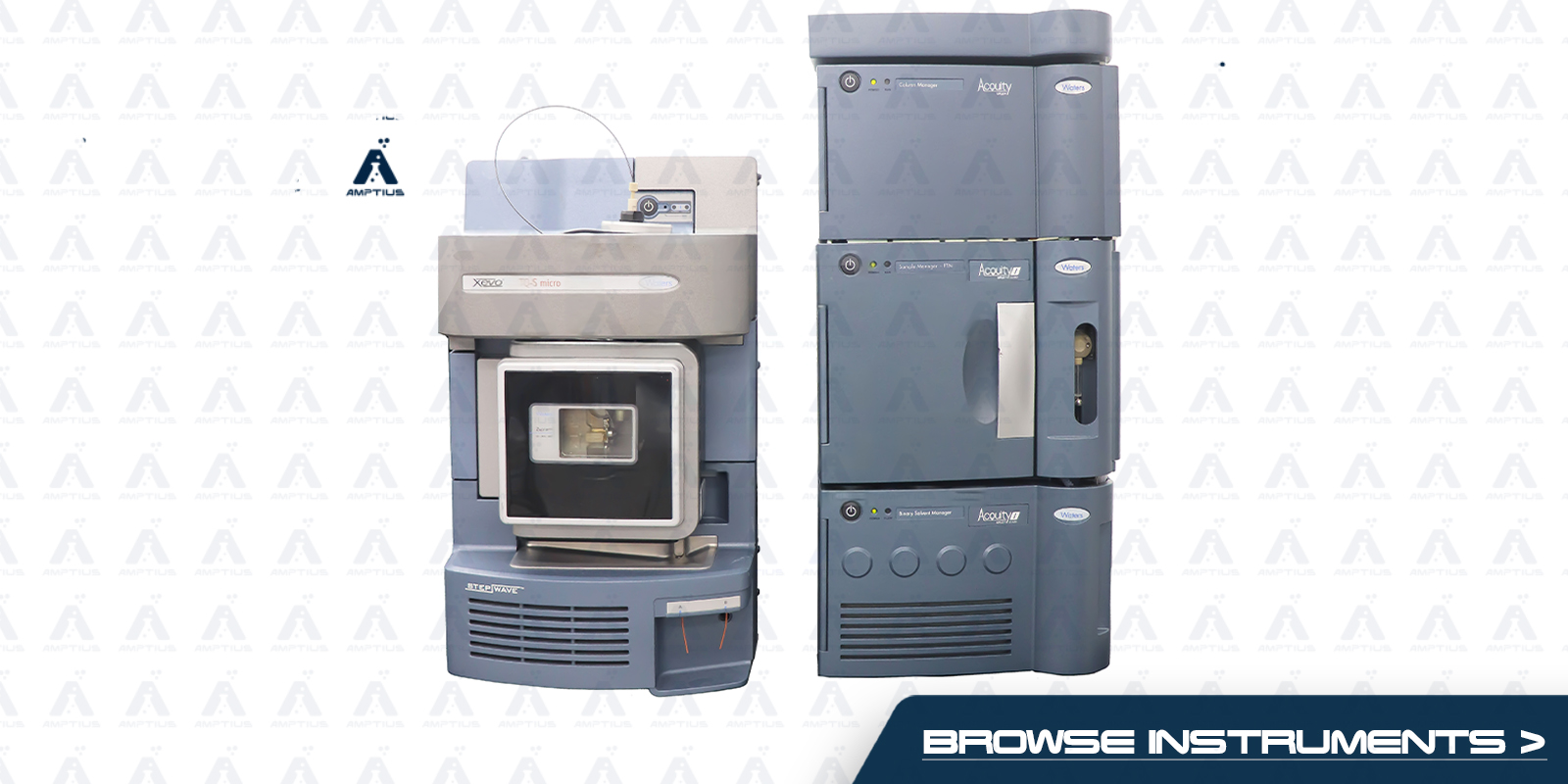
Waters Xevo TQ-S Micro Triple Quadrupole LC-MS/MS w/ Acquity I Class for AOAC Method SMPR 2016.002
The Waters Xevo TQ-S Micro LC-MS/MS system, combined with the ACQUITY I Class UPLC, provides ultra-sensitive detection of allergenic peptides in food matrices. StepWave ion optics and precise chromatographic control enable sub-ppm detection and accurate quantitation of allergenic compounds. This platform delivers excellent reproducibility and low carryover, making it ideal for routine AOAC SMPR 2016.002 workflows. Its strong chromatographic resolution supports reliable results across high-fat, processed, and complex food samples. Many food testing labs use this configuration to ensure regulatory compliance.
MassLynx software supports robust system validation with built-in calibration, audit trails, and automated ion ratio monitoring. The Xevo TQ-S Micro handles short cycle times and high-throughput operations without compromising sensitivity. Analysts benefit from consistent peak shapes, accurate retention times, and long-term performance stability. With validated methods and matrix-matched standards, the system reliably exceeds AOAC detection and quantitation targets. It stands out as a dependable platform for allergen quantification in cGMP-regulated labs.
Perkin Elmer QSight 420 LC/MS/MS Triple Quad System UHPLC Front End for AOAC Method SMPR 2016.002
The PerkinElmer QSight 420 LC-MS/MS system, paired with a UHPLC front end, delivers reliable allergen detection with strong sensitivity and excellent throughput. Its dual-source design and Enhanced Resolution Optics support trace-level quantitation in diverse food matrices. The QSight 420 offers consistent results over long runs, meeting AOAC SMPR 2016.002 limits for LOQ, MDL, and reproducibility. Many labs use it for routine analysis of processed foods, powders, and emulsions. Its rugged build and low maintenance needs make it a strong fit for high-volume environments.
Simplicity 3Q software supports full compliance by managing calibration curves, system checks, and documentation. Analysts can validate methods with ease and generate reports that meet cGMP recordkeeping standards. With strong peak integration, minimal carryover, and reliable signal stability, the QSight 420 ensures accurate allergen detection. It integrates smoothly into standard lab workflows and provides flexibility for expanding test panels. When paired with validated methods, this system ensures long-term method compliance and data quality.
Agilent Ultivo Triple Quad LC/MS/MS System w/ 1260 Infinity II for AOAC Method SMPR 2016.002
The Agilent Ultivo Triple Quadrupole LC-MS/MS, integrated with the 1260 Infinity II UHPLC, offers high sensitivity and small-footprint performance. With Jet Stream ionization and fast polarity switching, this system achieves excellent quantitation of allergenic peptides in both raw and processed food samples. Its compact size does not compromise performance, making it ideal for labs that need precision and space efficiency. The Ultivo meets all AOAC SMPR 2016.002 parameters for detection limits, accuracy, and reproducibility. Its robust operation supports daily use in compliance-driven testing facilities.
MassHunter software improves lab productivity with real-time validation tools, retention time tracking, and system suitability monitoring. Analysts can rely on clear, consistent results across diverse sample types. The Ultivo’s modular design allows flexible upgrades and supports validated workflows for allergen testing. When used with proper extraction and digestion protocols, it ensures compliance with AOAC guidelines. This system is an excellent fit for cGMP-compliant labs requiring high-throughput LC-MS/MS allergen analysis.
SCIEX Triple Quad™ 6500+ LC-MS/MS System for AOAC Method SMPR 2016.002
The SCIEX 6500+ Triple Quadrupole LC-MS/MS is engineered for ultra-trace quantitation of food allergens. With Turbo V ionization and Scheduled MRM Pro, it provides exceptional sensitivity and precision across complex food matrices. This system consistently achieves sub-ppm LOQs and meets all performance targets defined in AOAC SMPR 2016.002. Its rugged source design allows stable ion generation and minimizes variability over long sequences. Many laboratories choose this system for allergen quantitation in highly processed or mixed-ingredient products.
SCIEX OS software streamlines validation with full batch tracking, ion ratio verification, and audit-ready documentation. The 6500+ supports rapid sample turnaround while maintaining accuracy and repeatability. Analysts benefit from high-resolution MRM transitions and robust reproducibility. With validated workflows, this platform ensures full compliance with cGMP and AOAC method standards. It remains a top-tier solution for food testing labs seeking unmatched trace-level performance.
Thermo Scientific TSQ Altis Plus Triple Quadrupole LC-MS/MS for AOAC Method SMPR 2016.002
The Thermo Scientific TSQ Altis Plus Triple Quadrupole LC-MS/MS offers powerful sensitivity and quantitative accuracy for food allergen detection. Active Ion Management and efficient ion optics enhance signal quality while minimizing background noise. The system supports low-level detection of allergenic proteins with strong precision and retention time stability. It consistently meets MDL and LOQ targets required by AOAC SMPR 2016.002. The Altis Plus is suitable for labs managing diverse food product matrices under cGMP workflows.
TraceFinder software simplifies method validation and performance monitoring with built-in tools for calibration tracking and system verification. The platform supports high-throughput testing with short cycle times and excellent method repeatability. Analysts can confidently validate new methods and manage large sample batches efficiently. When integrated with Vanquish UHPLC, this system offers reliable chromatographic resolution and compliance with AOAC and regulatory standards. It is a leading option for precision-driven allergen testing labs.
Shimadzu LCMS-8060NX Triple Quadrupole with Nexera X3 UHPLC for AOAC Method SMPR 2016.002
The Shimadzu LCMS-8060NX Triple Quadrupole LC-MS/MS system, combined with Nexera X3 UHPLC, delivers high-speed, low-noise analysis for allergen detection. Advanced desolvation technology and fast polarity switching enable trace-level quantitation with excellent reproducibility. The platform excels in separating allergenic peptides in complex formulations and supports full AOAC SMPR 2016.002 compliance. It maintains precision and stability over extended runs and high sample volumes. Labs that require speed, sensitivity, and ruggedness benefit from this integrated system.
LabSolutions software supports automated method validation, internal standard tracking, and comprehensive data review. Its intuitive design helps minimize errors while streamlining cGMP documentation requirements. With matrix-matched calibration and validated preparation protocols, the LCMS-8060NX delivers repeatable results across different food types. This system combines throughput, stability, and compliance to support routine allergen monitoring under AOAC method guidelines. It is a dependable solution for contract labs and large-scale food manufacturers.
Choosing the Right LC-MS/MS System for AOAC Method SMPR 2016.002
- High-sensitivity systems: SCIEX 6500+, Thermo TSQ Altis Plus, and Waters Xevo TQ-S Micro provide excellent sub-ppm quantitation.
- Rugged and compact options: Agilent Ultivo and PerkinElmer QSight 420 offer reliable performance in space-constrained labs.
- High-throughput performers: Shimadzu LCMS-8060NX and SCIEX 6500+ support rapid analysis of multiple allergens in complex matrices.
AOAC SMPR 2016.002 demands highly sensitive and validated LC-MS/MS platforms capable of detecting trace allergens with precision and accuracy. The systems listed above meet or exceed these requirements and are proven in regulated allergen testing workflows. We offer certified refurbished LC-MS/MS systems tailored to support AOAC-compliant food allergen analysis. Contact us today to explore options that best suit your lab’s needs.