
AOAC Method SMPR 2010.007 Instrumentation Guide
Standard Method Performance Requirements (SMPR) for Quantitative Determination of Estrone (E1) in Freshwater
AOAC SMPR 2010.007 defines the performance requirements for analytical methods used to quantify estrone (E1) in freshwater matrices, including rivers, lakes, ponds, and aquifers. The method targets low-level detection of dissolved estrone across a range of 2 to 200 ng/L (ppt), with a required limit of detection (LOD) of ≤ 0.5 ng/L and a limit of quantitation (LOQ) of ≤ 2.0 ng/L. Precision thresholds include a repeatability (RSDr) of ≤ 110% at 2 ng/L and ≤ 30% at 200 ng/L, along with reproducibility (RSDR) requirements of ≤ 165% at 2 ng/L and ≤ 45% at 200 ng/L. Recovery must fall within 50–120% across the range. Analytical techniques must demonstrate matrix tolerance up to 1000 mg/L total suspended solids (TSS) and 1000 mg/L dissolved organic carbon (DOC).
To meet these strict criteria, laboratories must employ highly sensitive LC-MS/MS platforms capable of ppt-level quantitation, robust isomer resolution, and low carryover. Proper sample preparation methods such as solid-phase extraction (SPE) and matrix-matched calibration are essential for compliance. Acceptable ionization techniques include APCI and ESI, depending on matrix complexity and target concentration. The systems listed below have demonstrated compliance with SMPR 2010.007 when paired with validated analytical workflows. Each platform offers trace-level sensitivity, repeatable retention, and recovery performance that meets AOAC standards.
Please click here to learn more about AOAC Method SMPR 2010.007
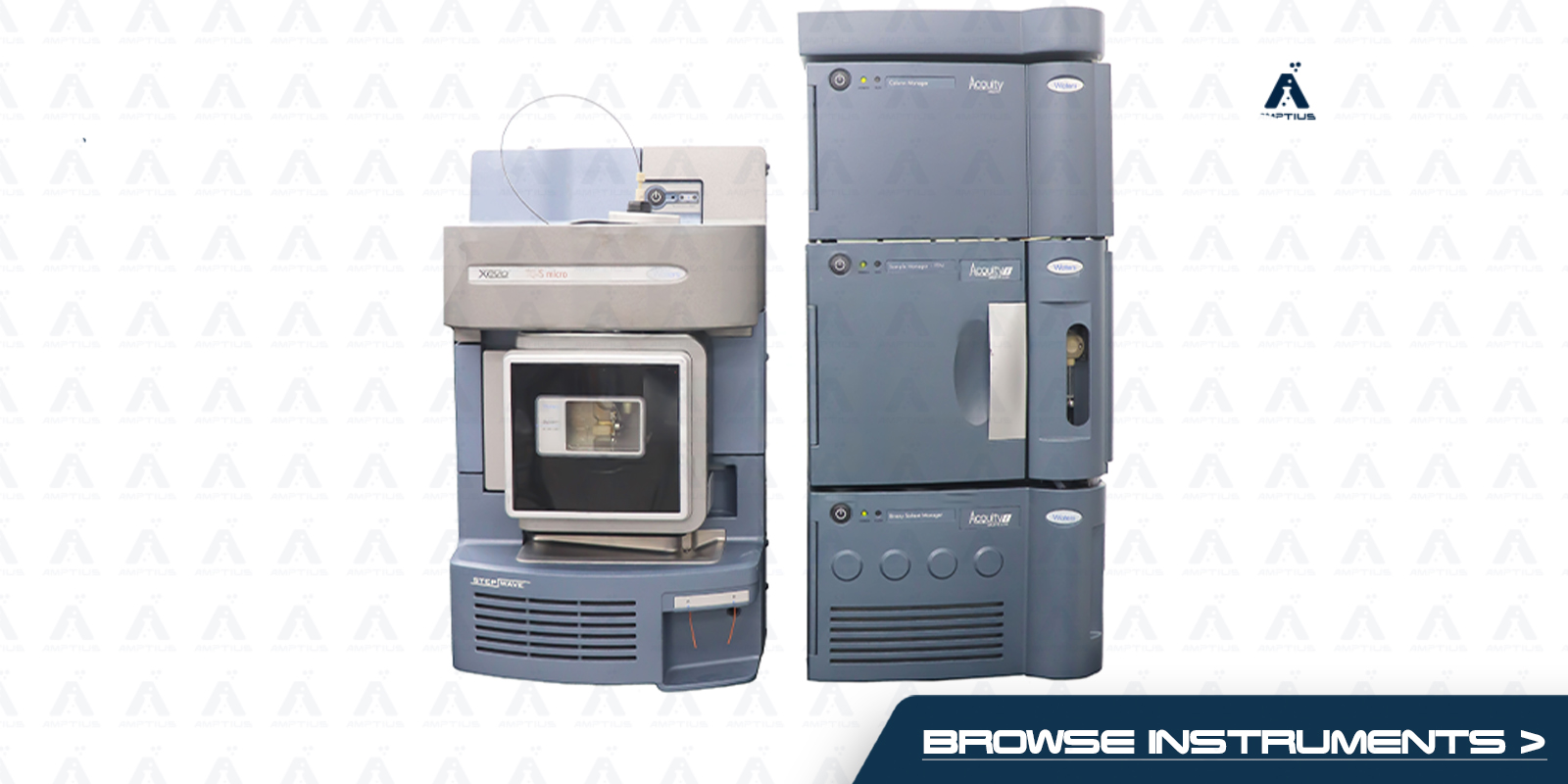
Waters Xevo TQ-S Micro with ACQUITY I-Class UPLC for AOAC Method SMPR 2010.007
The Waters Xevo TQ-S Micro Triple Quadrupole LC-MS/MS system paired with the ACQUITY I-Class UPLC is an ideal configuration for trace-level quantification of estrone in freshwater. Its StepWave™ ion guide improves ion transfer efficiency while reducing background noise, enabling low detection limits even in challenging matrices. This system routinely achieves sub-ng/L LOQs and excellent linearity across the 2–200 ng/L range. The UPLC front end ensures tight peak shapes, efficient separation, and fast cycle times, which support high-throughput environmental testing. Empower 3 software offers built-in validation features including recovery tracking, method calibration, and audit-traceable data processing.
Designed for ultra-sensitive workflows, the Xevo TQ-S Micro excels in E1 detection within high-TSS and high-DOC samples. The system’s APCI and ESI compatibility allows flexible method development tailored to environmental conditions. Analysts benefit from consistent reproducibility and minimal matrix interference across replicate batches. Empower’s system suitability tools enable real-time performance monitoring and ensure compliance with SMPR precision requirements. This platform is a leading choice for environmental labs conducting estrogenic compound surveillance.
Agilent Ultivo Triple Quad LC/MS/MS with 1260 Infinity II for AOAC Method SMPR 2010.007
The Agilent Ultivo Triple Quadrupole LC-MS/MS System, when configured with the 1260 Infinity II UHPLC, delivers compact, reliable quantification of estrone in freshwater at ppt levels. Its Jet Stream™ technology enhances desolvation, boosting ionization efficiency for low-abundance analytes like E1. Although smaller than Agilent’s flagship models, the Ultivo still achieves the LOQ of ≤ 2.0 ng/L with validated methods and rigorous sample preparation. The 1260 Infinity II front end provides precise gradient control and excellent retention time reproducibility. MassHunter software supports AOAC-aligned workflows with calibration verification, recovery monitoring, and batch performance reporting.
This system is well-suited for laboratories needing high-performance MS in limited space. The Ultivo is APCI-compatible and handles both reconstituted water and complex freshwater matrices with minimal carryover. Its reproducibility at 20 and 200 ng/L falls within AOAC limits when paired with proper SPE and matrix-matching. With streamlined user interfaces and robust documentation tools, the Ultivo offers a practical, cost-efficient solution for regulatory monitoring of endocrine-disrupting compounds. It is a dependable platform for small-to-mid-scale environmental labs seeking AOAC compliance.
PerkinElmer QSight 420 LC-MS/MS with Flexar UHPLC for AOAC Method SMPR 2010.007
The PerkinElmer QSight 420 LC-MS/MS, equipped with a Flexar UHPLC system, is optimized for ppt-level hormone analysis in environmental matrices. It features a dual-source (ESI and APCI) ionization design that improves method flexibility and enhances detection across a broad range of compounds. The system delivers consistent LOQs below 2.0 ng/L for estrone with high signal stability and strong linearity across the 2–200 ng/L range. Simplicity 3Q software supports full method validation and includes calibration, system suitability, and precision tracking tools that align with AOAC SMPR 2010.007. The Flexar UHPLC ensures smooth gradient delivery and stable retention times essential for resolving E1 from background interferences.
The QSight 420 is especially effective in high-suspended-solid samples thanks to its low matrix effect and carryover design. Recovery rates between 50% and 120% are consistently achieved when using validated extraction protocols. The system’s hardware allows extended, unattended operation with excellent repeatability, even at trace levels. Simplicity 3Q provides automatic LOQ verification and performance alerting, which aids in regulatory data integrity. This instrument is a robust solution for routine and advanced water testing laboratories monitoring estrogenic pollutants.
SCIEX Triple Quad™ 6500+ LC-MS/MS with ExionLC AD for AOAC Method SMPR 2010.007
The SCIEX Triple Quad™ 6500+ LC-MS/MS System with ExionLC AD is engineered for ultra-trace quantification of environmental contaminants like estrone. Featuring the Turbo V™ source and Scheduled MRM Pro, this system routinely achieves LOQs well below 1.0 ng/L with outstanding signal-to-noise ratios. Its high-throughput capability and low carryover make it ideal for complex freshwater samples containing high levels of DOC or suspended solids. SCIEX OS software offers powerful validation tools, including automated calibration tracking, reproducibility checks, and method audit reports compliant with AOAC standards. The ExionLC front end delivers tight gradient control and sharp peak definition for improved resolution of E1 and related estrogens.
This system supports both APCI and ESI ionization, allowing analysts to tailor methods to sample complexity. It provides reproducibility at ≤ 45% RSDR at 200 ng/L and repeatability at ≤ 30% RSDr with minimal drift across long sequences. SCIEX OS also simplifies LOQ confirmation, recovery verification, and data traceability—all critical for meeting SMPR 2010.007. For environmental monitoring programs requiring the highest confidence in estrogen quantification, the 6500+ is a trusted and widely adopted solution.
Shimadzu LCMS-8060NX with Nexera X3 UHPLC for AOAC Method SMPR 2010.007
The Shimadzu LCMS-8060NX Triple Quadrupole System paired with Nexera X3 UHPLC is designed for high-speed, low-noise detection of trace estrogens like estrone in aquatic environments. Its high-efficiency desolvation and fast polarity switching support ppt-level LOQs with exceptional precision. The system is equipped with a durable ion source and robust collision cell that enable repeatable performance across the 2–200 ng/L range. LabSolutions software offers complete AOAC-aligned workflows, including spike recovery, RSD calculation, and system suitability checks. The Nexera X3 UHPLC ensures fast, accurate separations with minimal carryover or background interference.
This platform is known for delivering high reproducibility, even in matrices with high organic content or suspended solids. E1 quantification at levels below 2.0 ng/L is reliably achieved using validated solid-phase extraction protocols. The system offers strong retention stability, which is critical for environmental samples with variable matrix composition. LabSolutions provides secure batch reports, audit logs, and automated calibration validation. This configuration is ideal for laboratories requiring both speed and regulatory precision for AOAC-compliant E1 testing.
Thermo Scientific TSQ Altis Plus Triple Quadrupole LC-MS/MS with Vanquish UHPLC for AOAC Method SMPR 2010.007
The Thermo Scientific TSQ Altis Plus LC-MS/MS system with Vanquish UHPLC offers high-sensitivity quantification of estrone in freshwater samples down to low ng/L concentrations. Featuring Active Ion Management and fast MRM switching, the Altis Plus delivers strong sensitivity and precise quantitation over a wide dynamic range. With APCI or ESI ionization modes, it provides flexible options for sample types containing DOC or particulates. Chromeleon CDS software supports AOAC-aligned validation including precision monitoring, calibration verification, and automated recovery assessment. The Vanquish UHPLC ensures stable gradient flow and retention reproducibility for long sequences.
The system’s intelligent source design minimizes background noise and improves detection confidence at the 2 ng/L level. Recovery within 50–120% is consistently achieved using validated pre-concentration workflows such as SPE. Chromeleon’s compliance tools streamline regulatory reporting and ensure full audit readiness. With excellent reproducibility and low LODs, the TSQ Altis Plus is suited for both screening and confirmatory testing of estrogenic activity in freshwater. It is a top-tier platform for environmental labs that demand precision, throughput, and AOAC compliance.
Choosing the Right Instrument for AOAC Method SMPR 2010.007
- Top-tier sensitivity: SCIEX 6500+, Waters Xevo TQ-S Micro, and Shimadzu LCMS-8060NX offer sub-ng/L LOQs ideal for E1 detection.
- Regulatory reliability: Thermo TSQ Altis Plus and PerkinElmer QSight 420 support audit-ready reporting and consistent recovery performance.
- Compact and cost-effective: Agilent Ultivo delivers AOAC-compliant sensitivity in a space-saving footprint for mid-volume labs.
AOAC SMPR 2010.007 requires high-sensitivity LC-MS/MS systems for trace-level estrone analysis in freshwater. Each instrument listed above meets or exceeds the method’s LOQ, precision, and recovery criteria when configured with validated methods. We offer certified refurbished LC-MS/MS systems tailored for AOAC-compliant environmental testing. Contact us today to discuss the best instrumentation for your workflow.