
AOAC Method SMPR 2010.002 Instrumentation Guide
Standard Method Performance Requirements (SMPR) for PCR Detection of Yersinia pestis in Aerosol Collection Filters and Liquids
AOAC SMPR 2010.002 sets the performance benchmarks for polymerase chain reaction (PCR) methods used to detect Yersinia pestis in aerosol collection filters and liquid samples. The method must achieve an acceptable minimum detection level (AMDL) of 20,000 cells per filter or 2,000 cells/genome equivalents per milliliter. Detection at these levels must meet a 5% lower confidence limit on the probability of detection (POD) of 0.95 or greater. In addition, all target strains must be detected with 100% consistency, and cross-reactivity with non-target species must not occur. These criteria are essential for reliable public health response and environmental monitoring.
The method also requires robust performance in the presence of environmental interferences such as dust, bacteria, and fungal spores. Reproducibility must be demonstrated across three independent laboratories, each producing at least ten valid data sets using standardized protocols. False positives and false negatives must remain within specified POD limits under collaborative validation. The following real-time PCR instruments are well-suited for this method when paired with validated Y. pestis assays. Each system provides the sensitivity, precision, and regulatory readiness needed for compliance with AOAC SMPR 2010.002.
Please click here to learn more about AOAC Method SMPR 2010.002
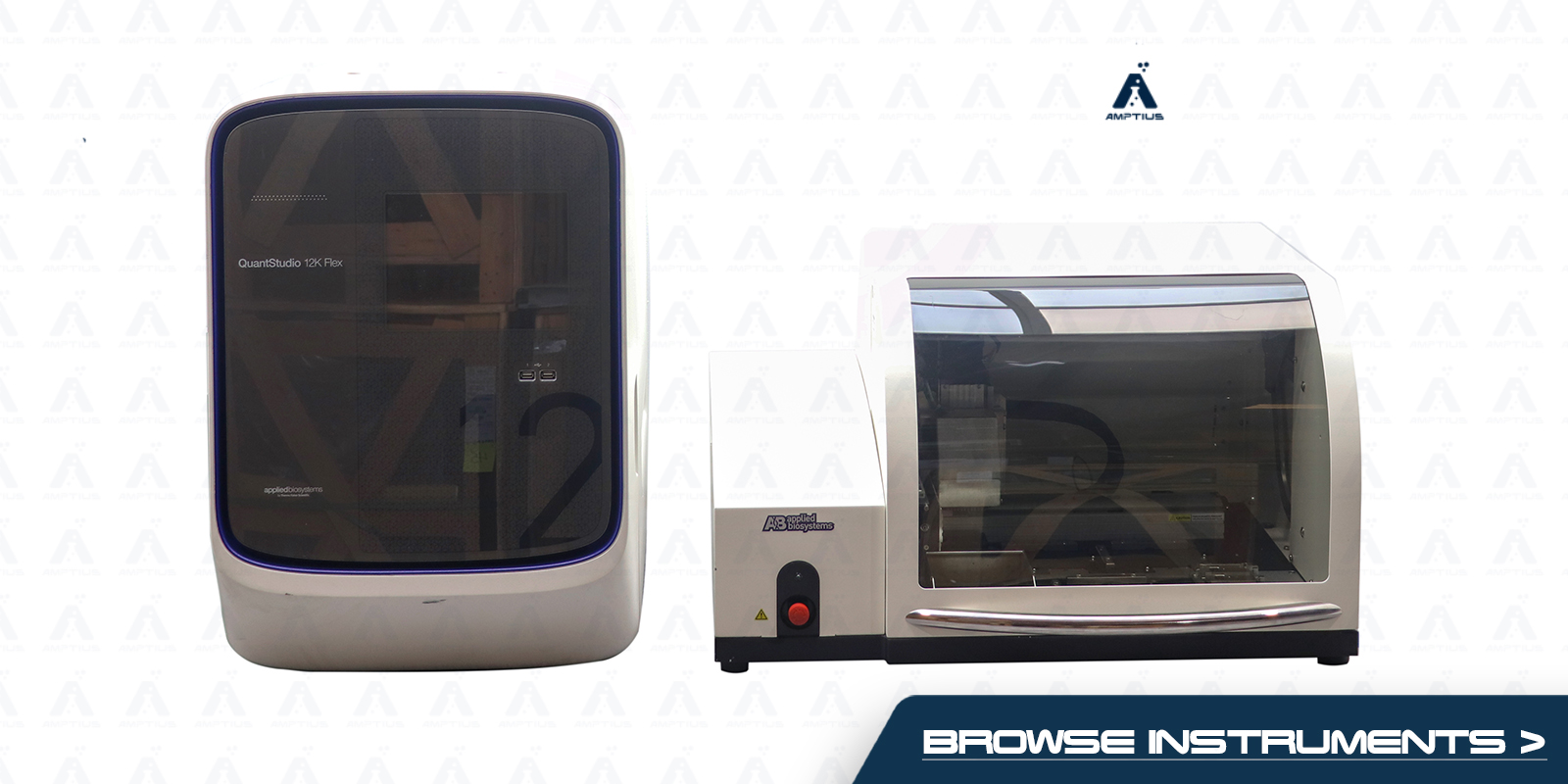
Applied Biosystems QuantStudio™ 12K Flex Real-Time PCR System for AOAC Method SMPR 2010.002
The QuantStudio™ 12K Flex Real-Time PCR System from Applied Biosystems is designed for high-throughput testing with unmatched thermal consistency and optical precision. It supports 384-well plates and OpenArray® formats, making it ideal for laboratories conducting large-scale screening and surveillance. This platform provides fast run times, uniform amplification, and flexible assay support for both SYBR Green and TaqMan chemistries. Its ability to detect Yersinia pestis at low concentrations has made it a trusted solution for public health and biosecurity applications. The system’s design ensures repeatable results across a wide range of environmental matrices.
QuantStudio software features advanced tools for calibration tracking, result validation, and audit trail generation. These capabilities help ensure compliance with laboratory quality assurance protocols and AOAC performance requirements. The system allows for automated sample analysis with minimal operator input, reducing the potential for human error. It supports robust data integrity and security features for traceability in regulated environments. When used with validated Y. pestis PCR assays, this platform meets all criteria set forth by AOAC SMPR 2010.002.
BioFire FilmArray Torch System for AOAC Method SMPR 2010.002
The BioFire FilmArray Torch System is an automated molecular diagnostic platform that integrates sample preparation, amplification, and detection into a single closed system. It is engineered to minimize contamination risks while delivering results in under an hour, making it suitable for rapid-response and biodefense applications. The system supports customizable or preloaded pathogen panels, including assays capable of detecting Yersinia pestis. Its modular design allows for high-throughput processing with scalable capacity to support surge testing demands. The intuitive workflow and cartridge-based operation make it accessible for both experienced and novice users.
The Torch System has demonstrated strong POD performance at the AMDL and maintains specificity at high near-neighbor concentrations. Its reproducibility across replicates and laboratories aligns with the collaborative validation study requirements outlined in the SMPR. The system’s software provides internal controls, automated QC checks, and secure reporting suitable for regulated environments. It is widely used in clinical and environmental settings where speed and reliability are critical. When equipped with a validated assay, the BioFire Torch meets the full range of requirements in AOAC SMPR 2010.002.
Bio-Rad CFX96 Touch Real-Time PCR Detection System for AOAC Method SMPR 2010.002
The Bio-Rad CFX96 Touch Real-Time PCR Detection System is known for its high-speed thermal cycling and optical accuracy across 96 wells. It enables multiplex analysis with five optical channels, allowing simultaneous detection of multiple targets such as Yersinia pestis and internal controls. The system supports SYBR Green, probe-based chemistries, and melt curve analysis, providing flexibility for assay development and validation. Its temperature uniformity and rapid ramp rates ensure reliable amplification in both low and high complexity matrices. These features are critical for meeting AMDL and POD requirements in aerosol filter and liquid sample testing.
CFX Maestro software offers powerful tools for POD assessment, real-time amplification curve review, and automated reporting. It supports full traceability and data integrity in line with regulatory expectations for laboratory quality systems. The system’s intuitive interface and flexible configuration options make it a practical solution for routine surveillance and emergency testing scenarios. It has been validated across a wide range of public health laboratories. When used with a qualified Y. pestis PCR assay, the CFX96 platform supports full compliance with AOAC SMPR 2010.002.
Roche LightCycler® 480 II Real-Time PCR System for AOAC Method SMPR 2010.002
The Roche LightCycler® 480 II is a real-time PCR platform built for precision and reproducibility in high-throughput workflows. It offers compatibility with both 96- and 384-well plates, allowing for scalable testing based on lab throughput requirements. The system’s proprietary temperature control and optical technology enable accurate detection of low-copy Yersinia pestis DNA. It supports hydrolysis probe and intercalating dye chemistries, making it flexible for different assay formats. These attributes make the system suitable for regulated PCR testing under AOAC guidance.
The LightCycler software includes features such as calibration monitoring, data locking, and audit trails to support GLP-compliant workflows. Its analysis capabilities include outlier detection and POD calculation tools for method validation. The system is widely adopted in national reference laboratories for biosecurity and pathogen detection. With proper assay configuration, it demonstrates full adherence to the inclusivity, exclusivity, and reproducibility requirements of AOAC SMPR 2010.002. It remains one of the most trusted real-time PCR platforms for environmental and biodefense testing.
Qiagen Rotor-Gene Q Real-Time PCR Cycler for AOAC Method SMPR 2010.002
The Qiagen Rotor-Gene Q Real-Time PCR Cycler uses a unique rotary design that eliminates thermal edge effects and ensures uniform temperature distribution. This design enhances PCR efficiency and precision, supporting accurate detection of Yersinia pestis in aerosol and liquid samples. The system accommodates multiple chemistries and supports high-resolution melt analysis, improving flexibility during method development. Its modular construction simplifies maintenance and reduces risk of cross-contamination. These features make it well-suited for POD-sensitive applications requiring minimal variance.
The Rotor-Gene software includes robust data management, compliance tracking, and customizable analysis workflows. Built-in controls and security features help laboratories comply with AOAC validation standards and GLP documentation protocols. The system is frequently used in mobile labs and low-throughput environments where footprint and ease-of-use are important. It is known for high reproducibility and low background noise, even with environmental interference present. When configured with an AOAC-validated Y. pestis assay, the Rotor-Gene Q meets all critical performance thresholds.
Choosing the Right Instrument for AOAC Method SMPR 2010.002
- High-throughput compliance: Applied Biosystems QuantStudio™ 12K Flex supports large-volume testing with excellent reproducibility.
- Fully automated solution: BioFire® FilmArray® Torch offers rapid, cartridge-based workflows ideal for biosecurity settings.
- Flexible PCR testing: Bio-Rad CFX96 Touch and Qiagen Rotor-Gene Q offer customizable assays and precise POD performance.
- Regulatory-grade validation: Roche LightCycler® 480 II supports scalable formats and built-in tools for GLP/GMP compliance.
Each instrument listed here supports the critical POD, specificity, and reproducibility criteria outlined in AOAC SMPR 2010.002. These systems, when paired with validated assays for Yersinia pestis, enable laboratories to maintain reliable pathogen detection in environmental and public health workflows. We provide certified refurbished real-time PCR systems configured for AOAC-compliant use. Contact us today to explore solutions tailored to aerosol and filter-based pathogen analysis.