
AOAC Method SMPR 2009.001 Instrumentation Guide
Standard Method Performance Requirements (SMPR) for Quantitative Methods for Drug Residues in Shrimp, Tilapia, Catfish, and Salmon
AOAC SMPR 2009.001 outlines method performance requirements for the quantitative analysis of veterinary drug residues in seafood species including shrimp, tilapia, catfish, and salmon. The standard applies to residues below 1 mg/kg and covers multiple drug classes such as chloramphenicol, nitrofurans, fluoroquinolones, quinolones, malachite green, and methyltestosterone. Detection limits must be as low as 0.15 mg/kg, with LOQs ranging from 0.3 to 1.0 mg/kg depending on the analyte. Precision is defined by relative standard deviation (RSD): chloramphenicol and methyltestosterone allow up to 54% RSD, while nitrofurans, fluoroquinolones, and quinolones must meet an RSD threshold of ≤ 46%. Recovery expectations also vary: 40–120% for chloramphenicol, malachite green, and methyltestosterone, and 60–115% for nitrofurans, fluoroquinolones, and quinolones.
These performance requirements are specifically intended for single-laboratory validation (SLV) studies. High-performance LC-MS/MS platforms are essential for achieving the required detection limits, precision, and recovery targets in complex seafood matrices. Each instrument listed below offers capabilities suitable for use in validated methods aligned with AOAC SMPR 2009.001. These systems—when combined with appropriate sample preparation protocols and matrix-matched calibration—can support full SLV compliance for drug residue testing in food safety and regulatory environments.
Please click here to learn more about AOAC Method SMPR 2009.001
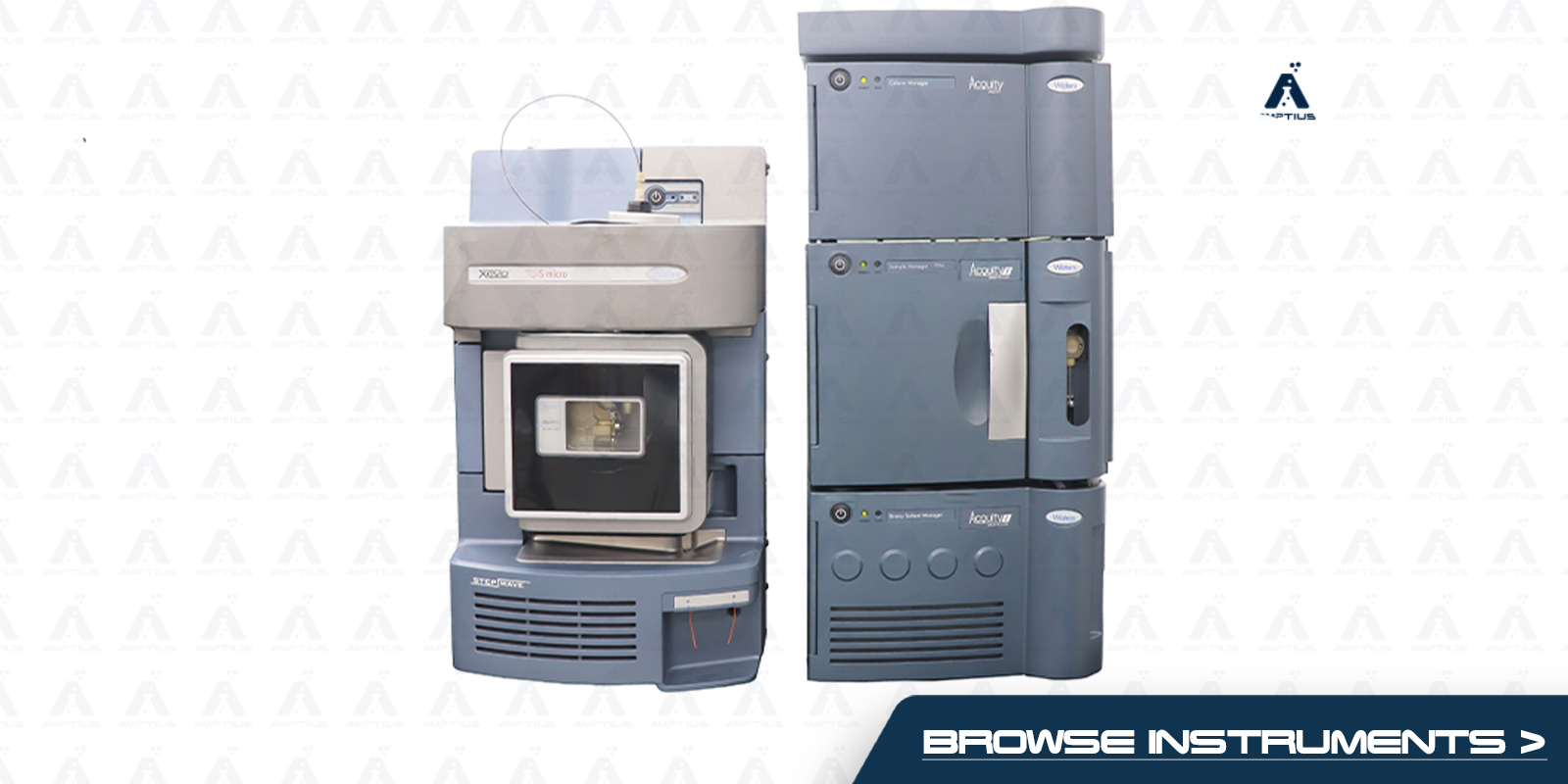
Waters Xevo TQ-S Micro LC-MS/MS with ACQUITY UPLC I-Class for AOAC Method SMPR 2009.001
The Waters Xevo TQ-S Micro, coupled with the ACQUITY UPLC I-Class, provides high-sensitivity detection for multi-class drug residues in seafood. Its StepWave ion optics, paired with fast UPLC separations, support precise quantitation of nitrofurans, chloramphenicol, and malachite green derivatives at levels well below 1 mg/kg. The platform consistently achieves LOQs within the required 0.3–1.0 mg/kg range. Precision and recovery performance, when used with validated protocols, align with the SMPR targets for each analyte class. This instrument setup is suitable for single-lab validations of seafood residue methods.
MassLynx software facilitates SLV documentation with support for ion ratio checks, retention time monitoring, and automated calibration. Its batch acquisition and audit-ready reporting features are useful in regulatory method development. When combined with matrix-specific standards and internal controls, this system can meet AOAC’s performance expectations. Its reliability in high-throughput residue workflows makes it a strong choice for SLV implementation in food safety labs. The Xevo TQ-S Micro is a validated-capable LC-MS/MS solution for seafood drug residue analysis.
Agilent Ultivo Triple Quad LC/MS/MS System with 1260 Infinity II Front End for AOAC Method SMPR 2009.001
The Agilent Ultivo Triple Quad LC/MS/MS System offers compact performance for the quantification of chloramphenicol, methyltestosterone, and other veterinary drugs in aquatic matrices. Its Vortex collision cell and flexible MRM capabilities deliver strong reproducibility and specificity, achieving analyte-specific LOQs within the AOAC range. It supports RSD values of ≤ 54% for certain analytes and ≤ 46% for others, as required. Recovery performance remains within the required 40–120% or 60–115% bands, depending on the compound class. The Ultivo platform is well-suited for laboratories performing SLV studies on fish tissue.
MassHunter software enables data validation, system suitability monitoring, and real-time QC oversight. These features support SLV processes when configured in validated workflows. The compact design conserves bench space while maintaining robust analytical performance. Its reliability in trace quantitation workflows makes it a capable platform for AOAC-aligned method development. This configuration supports complete SLV documentation and method performance tracking as outlined in SMPR 2009.001.
SCIEX Triple Quad™ 6500+ LC-MS/MS System with ExionLC AD for AOAC Method SMPR 2009.001
The SCIEX 6500+ Triple Quad LC-MS/MS, coupled with the ExionLC AD system, provides ultra-trace detection suitable for SLV of veterinary drug residue methods. Turbo V ionization and Scheduled MRM Pro allow for stable and accurate detection of low-abundance targets including fluoroquinolones and chloramphenicol. The system routinely meets AOAC LOQ and RSD requirements for all specified analyte classes. Its reproducibility across batch sequences supports consistent performance in validation environments. Recovery can be maintained within the appropriate AOAC-defined ranges when validated with matrix-matched calibrants.
SCIEX OS software provides automated batch review, system suitability checks, and compliance documentation for SLV. Custom templates help ensure consistent method performance tracking. This system supports comprehensive SLV reporting and performance verification as required by AOAC SMPR 2009.001. Its established use in residue screening makes it suitable for both method development and high-throughput regulatory workflows. When paired with appropriate extraction and cleanup protocols, the 6500+ is a strong performer for seafood residue analysis.
Thermo Scientific TSQ Altis Plus Triple Quadrupole LC-MS/MS for AOAC Method SMPR 2009.001
The Thermo Scientific TSQ Altis Plus is designed for high-sensitivity quantification of veterinary drug residues across aquatic matrices. Its Active Ion Management and high-speed MRM capabilities enable clear signal acquisition for difficult analytes like malachite green and methyltestosterone. The system meets the LOQ, precision, and recovery targets defined in SMPR 2009.001 for all six drug classes when validated accordingly. Its hardware and software integration supports rugged batch operation in SLV environments. This instrument is particularly effective for lipid-rich or protein-heavy seafood matrices.
TraceFinder software includes templates for AOAC-aligned validation tracking, recovery assessment, and method suitability review. These tools support the generation of audit-ready reports for SLV documentation. The Altis Plus provides robust ion stability and high scan speed for simultaneous analysis of multiple drug classes. With appropriate sample preparation and validation, it fully supports the performance benchmarks of SMPR 2009.001. It is a strong platform for labs conducting SLV for import/export monitoring and food safety programs.
Shimadzu LCMS-8060NX Triple Quadrupole with Nexera X3 UHPLC for AOAC Method SMPR 2009.001
The Shimadzu LCMS-8060NX triple quadrupole system, combined with Nexera X3 UHPLC, offers ultra-fast, low-noise quantitation of veterinary drug residues. This system achieves LODs and LOQs required by AOAC for challenging compounds such as nitrofurans, malachite green, and quinolones. It supports MRM transitions with rapid polarity switching and minimal carryover. RSD and recovery values remain within AOAC specifications when configured for SLV with matrix-specific standards. Its signal stability across extended batch runs enhances reproducibility and reliability in validation studies.
LabSolutions software enables internal standard tracking, QC trend visualization, and real-time method performance review. When implemented with validated workflows, it supports complete AOAC SMPR 2009.001 documentation. This configuration is suitable for single-laboratory validation of multi-residue methods in seafood safety testing. Its precision, robustness, and speed make it well-suited for regulated method development in both national and international food programs.
Choosing the Right Instrument for AOAC Method SMPR 2009.001
- Top-tier sensitivity and throughput: SCIEX 6500+ and Waters Xevo TQ-S Micro deliver high precision and low LOQs suitable for SLV workflows.
- Compact and efficient: Agilent Ultivo LC-MS/MS offers space-saving performance aligned with AOAC criteria.
- Validation-focused platforms: Thermo TSQ Altis Plus and Shimadzu LCMS-8060NX provide strong SLV support with built-in method tracking tools.
AOAC SMPR 2009.001 sets performance criteria specifically for single-laboratory validation (SLV) of methods analyzing veterinary drug residues in seafood. The instruments above are suitable for use in validated workflows that meet required precision, recovery, and sensitivity standards. We offer certified refurbished LC-MS/MS platforms optimized for AOAC-compliant multi-class residue testing. Contact us today to explore SLV-ready solutions for your laboratory.
