
AOAC Method SMPR 2018.011 Instrumentation Guide
Standard Method Performance Requirements (SMPR) for Identification and Quantitation of Selected Pesticide Residues in Dried Cannabis Materials
AOAC SMPR 2018.011 establishes the minimum performance requirements for methods that identify and quantify pesticide residues in dried cannabis materials. These include flower, trim, and ground forms, covering over 100 targeted analytes. Methods must achieve limits of quantitation (LOQs) that meet or exceed the analyte-specific targets outlined in Table 1 of the SMPR, with many set at or below 2 µg/kg. Required method performance includes 70–120% recovery, RSDr ≤ 15%, RSDR ≤ 25%, and linearity of R² ≥ 0.995.
Analytical platforms such as GC-MS/MS and LC-MS/MS are commonly used to meet these requirements using MRM acquisition for compound-specific quantitation. Instruments must distinguish co-eluting compounds in complex cannabis matrices and deliver reproducible retention time stability. Validated workflows should confirm identity through retention time agreement and selective ion transitions, ensuring accuracy and specificity. The systems below support these performance criteria and are widely used in commercial cannabis laboratories for regulatory compliance.
Please click here to learn more about AOAC Method SMPR 2018.011
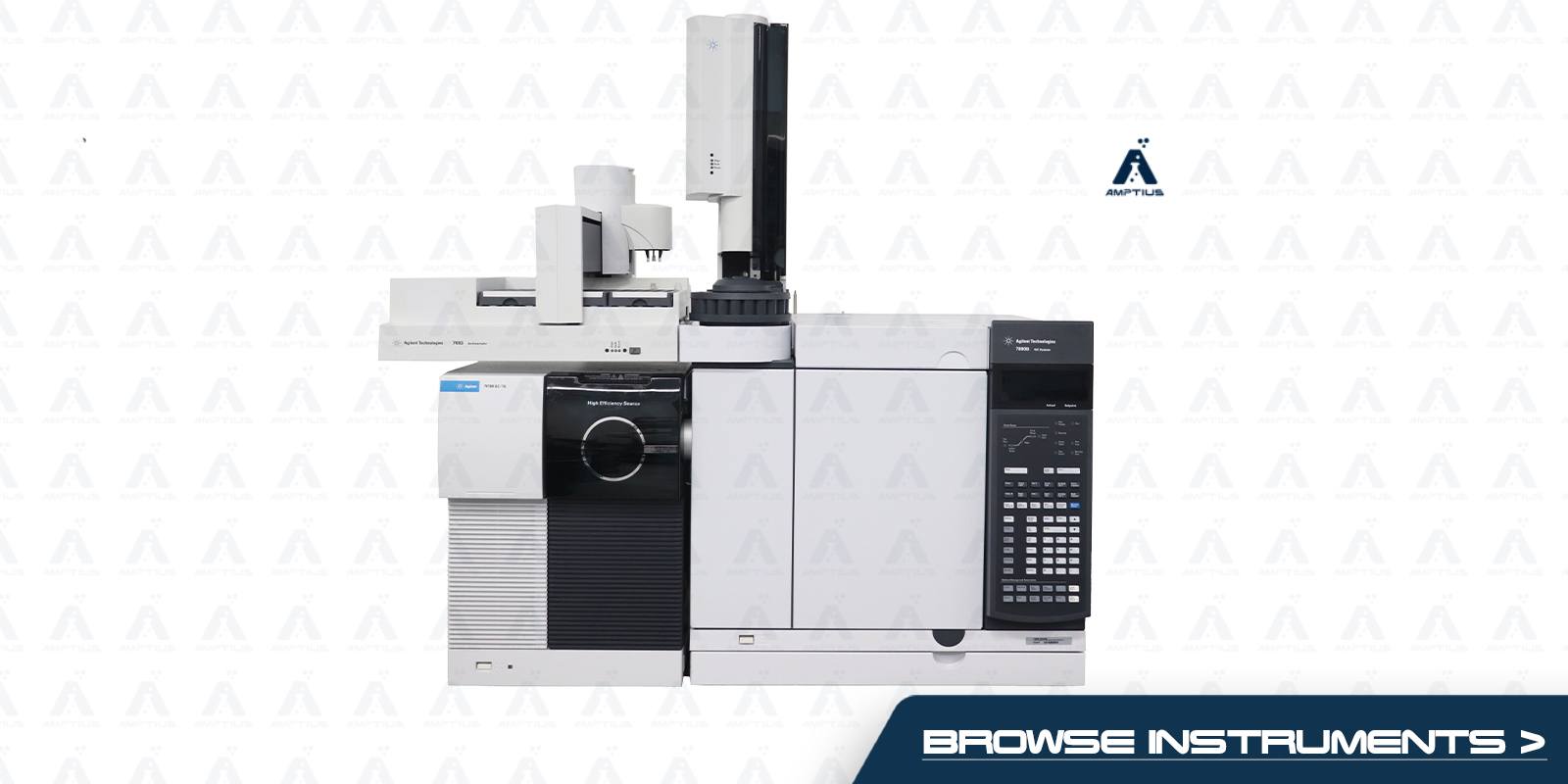
Agilent 7890B GC with 7010B Triple Quadrupole MS and 7693 Autosampler for AOAC Method SMPR 2018.011
The Agilent 7890B GC with 7010B Triple Quadrupole MS delivers high-sensitivity GC-MS/MS performance for pesticide analysis in cannabis matrices. This system provides excellent retention time stability, MRM-based detection, and robust quantifier/qualifier ion confirmation for volatile and semi-volatile pesticide residues. The 7010B’s EI source and enhanced ion optics ensure consistent results at or below 2 µg/kg, meeting AOAC sensitivity and precision standards. Paired with the 7693 Autosampler, it enables automated injections and high-throughput processing.
Agilent’s MassHunter software streamlines calibration, transition scheduling, and data reporting, ensuring regulatory compliance and method validation. The system supports validated pesticide panels used by cannabis testing labs across North America. Its performance for organochlorines, pyrethroids, and other GC-amenable compounds is widely documented. With consistent quantitation, rugged hardware, and proven regulatory support, this platform is ideal for labs seeking reproducible cannabis pesticide testing workflows.
Waters Xevo TQ-GC Triple Quadrupole with Agilent 8890 GC and PAL RSI Autosampler for AOAC Method SMPR 2018.011
The Waters Xevo TQ-GC Triple Quadrupole GC-MS/MS System combined with the Agilent 8890 GC and PAL RSI Autosampler provides sensitive and selective detection of pesticides in cannabis. This platform supports MRM acquisition with precise transition control and low detection limits, ideal for regulated pesticide panels. The Agilent 8890 ensures chromatographic reproducibility while the PAL RSI autosampler provides accurate and automated injection routines. Together, the system delivers excellent LOQ performance and matrix robustness.
Waters MassLynx software simplifies multi-residue method development, validation, and spectral review. Analysts benefit from seamless calibration tracking, integrated sample lists, and compliance-ready documentation. This configuration performs reliably for pyrethroids, organophosphates, and other challenging analyte classes. With powerful quantitation and automation features, it supports commercial labs seeking high-throughput, validated GC-MS/MS workflows for cannabis safety testing.
Thermo Scientific TRACE 1310 GC with TSQ 9610 Triple Quadrupole for AOAC Method SMPR 2018.011
The TRACE 1310 GC with TSQ 9610 Triple Quadrupole MS from Thermo Scientific offers ultra-sensitive GC-MS/MS performance for pesticide screening in cannabis. The system’s advanced source design, fast SRM switching, and low noise floor enable reliable detection of target analytes at sub-ppb levels. The TRACE 1310 delivers precise retention time control with high repeatability, essential for regulated pesticide residue methods under SMPR 2018.011.
Thermo’s TraceFinder software integrates quantitation, validation, and audit-ready reporting in a single platform. The TSQ 9610 enables simultaneous detection of multiple residues with consistent ion ratios and spectral confirmation. Its robust operation in cannabis matrices helps laboratories meet precision, recovery, and sensitivity goals. This system is a top-tier solution for labs performing high-throughput GC-MS/MS workflows under strict regulatory guidelines.
Shimadzu GCMS-TQ8050 NX with AOC-20i Autosampler for AOAC Method SMPR 2018.011
The Shimadzu GCMS-TQ8050 NX with AOC-20i Autosampler offers industry-leading detection limits and quantitative performance for pesticide analysis in cannabis. Its high-efficiency collision cell, ultra-fast MRM acquisition, and EI ionization deliver reproducible results across complex sample matrices. The system supports validated multi-residue methods and confirms identity with quantifier and qualifier transitions. Automated injection via the AOC-20i enhances precision and supports 24/7 lab workflows.
Shimadzu’s LabSolutions software ensures accurate calibration, ion ratio verification, and batch reporting. The TQ8050 NX provides excellent long-term stability, minimizing maintenance while ensuring method compliance. Its ultra-trace detection capability and high analytical throughput make it ideal for cannabis testing facilities. The system reliably meets SMPR 2018.011 requirements for recovery, linearity, and LOQ across diverse pesticide classes.
Scion Instruments 436-GC with Scion TQ MS for AOAC Method SMPR 2018.011
The Scion 436-GC with Scion TQ MS provides robust and reliable GC-MS/MS analysis of regulated pesticides in dried cannabis products. It enables full compliance with AOAC performance requirements through sensitive MRM detection and dual ion confirmation. The Scion TQ MS is optimized for multi-analyte pesticide panels and delivers excellent LOQs even in heavy matrix backgrounds. Its intuitive software and stable GC operation ensure retention time consistency and peak reproducibility.
This platform is ideal for labs that require validated GC-MS/MS methods at high throughput. Automated acquisition routines and powerful spectral libraries improve confirmation accuracy and confidence in results. Scion’s integrated system design makes it a durable and cost-effective solution for compliance-driven cannabis testing environments. It supports AOAC SMPR 2018.011 performance criteria for trace pesticide analysis.
Waters Xevo TQ-S Micro Triple Quadrupole LC-MS/MS with ACQUITY I-Class for AOAC Method SMPR 2018.011
The Waters Xevo TQ-S Micro LC-MS/MS paired with the ACQUITY I-Class UHPLC provides high sensitivity and exceptional matrix tolerance for pesticide quantitation in cannabis. This system delivers rapid MRM acquisition, stable retention times, and LOQs that meet AOAC targets. Its StepWave ion optics improve signal-to-noise ratios and reduce matrix interference, ensuring accurate detection across a wide pesticide panel.
Waters’ MassLynx software supports real-time monitoring of quantifier and qualifier transitions and automates recovery, RSD, and calibration checks. The system excels at analyzing non-volatile, polar compounds such as neonicotinoids and carbamates. With proven performance across a variety of cannabis matrices, it is a trusted solution in both R&D and regulatory testing labs. Its compact design and method reliability make it ideal for high-throughput pesticide screening.
Agilent Ultivo Triple Quadrupole LC-MS/MS with 1260 Infinity II for AOAC Method SMPR 2018.011
The Agilent Ultivo LC-MS/MS system, coupled with the 1260 Infinity II UHPLC, is optimized for trace pesticide residue analysis in dried cannabis. Its compact triple quadrupole design supports high-sensitivity MRM quantitation for LC-amenable pesticides including fungicides, insecticides, and herbicides. The system consistently meets AOAC limits for LOQ, linearity, and repeatability, making it a strong match for regulated testing workflows.
With Agilent’s MassHunter software, labs benefit from seamless method setup, data validation, and audit-ready reports. The Jet Stream ESI interface enhances detection limits and peak reproducibility, even in challenging cannabis matrices. The Ultivo system is ideal for small labs needing full LC-MS/MS capability in a smaller footprint. Its efficiency and accuracy support full SMPR 2018.011 compliance across multi-residue panels.
PerkinElmer QSight 420 LC-MS/MS with UHPLC for AOAC Method SMPR 2018.011
The PerkinElmer QSight 420 LC-MS/MS system with UHPLC delivers high-throughput, accurate quantitation of pesticide residues in cannabis. Its dual-source design enables efficient ionization and rapid polarity switching, essential for broad pesticide panels. With low detection limits, excellent signal stability, and easy calibration setup, the QSight 420 meets or exceeds all SMPR 2018.011 performance requirements.
PerkinElmer’s Simplicity software simplifies batch analysis, curve validation, and compliance tracking. The system is well-suited for challenging cannabis matrices, offering consistent quantifier/qualifier ratios and strong matrix tolerance. This platform supports labs that prioritize speed, precision, and workflow reliability. It is a proven solution for multi-residue pesticide screening under strict regulatory standards.
Thermo Scientific TSQ Altis Plus with Vanquish UHPLC for AOAC Method SMPR 2018.011
The TSQ Altis Plus Triple Quadrupole from Thermo Scientific, combined with Vanquish UHPLC, delivers ultra-sensitive LC-MS/MS quantitation for pesticide analysis in dried cannabis. Active Ion Management ensures precise ion focusing, while rapid MRM switching supports large analyte panels. This system consistently meets LOQ and recovery requirements in cannabis testing, with strong performance for matrix-heavy samples.
TraceFinder software integrates quant/qual verification, curve fitting, and regulatory reporting into a single interface. The system’s accuracy and flexibility make it ideal for comprehensive pesticide residue programs. Whether detecting neonicotinoids, organophosphates, or fungicides, the TSQ Altis Plus performs with precision. It’s a top-tier platform for AOAC-compliant pesticide quantitation.
Shimadzu LCMS-8060NX with Nexera X3 UHPLC for AOAC Method SMPR 2018.011
The Shimadzu LCMS-8060NX system with Nexera X3 UHPLC provides high-speed, high-sensitivity pesticide quantitation for cannabis testing under SMPR 2018.011. Its ultra-fast polarity switching and advanced MRM performance allow detection of trace analytes across large pesticide panels. Nexera X3 ensures reliable chromatographic separation with reproducible gradients and minimal carryover.
LabSolutions software supports full method validation with integrated RSD tracking, calibration curve verification, and batch reporting. The system performs well across both high-volume and matrix-rich cannabis extracts. With stable signal output and low LOQ capabilities, the LCMS-8060NX supports rigorous compliance in licensed cannabis laboratories. It’s ideal for routine regulatory workflows involving LC-amenable pesticides.
SCIEX Triple Quad™ 6500+ LC-MS/MS with ExionLC AD for AOAC Method SMPR 2018.011
The SCIEX 6500+ LC-MS/MS system paired with the ExionLC AD UHPLC is a high-end platform designed for ultra-trace pesticide quantification in cannabis. Turbo V ion source and Scheduled MRM Pro ensure sensitivity, precision, and efficient transition scheduling across complex sample sets. The system consistently meets AOAC performance criteria including LOQ ≤ 2 µg/kg and R² ≥ 0.995.
SCIEX OS software simplifies compliance workflows through customizable acquisition templates, real-time flagging, and audit-ready reporting. With minimal matrix effects and exceptional long-term stability, the 6500+ is ideal for demanding cannabis testing operations. It supports confident quantitation across hundreds of samples and analytes. This system is a trusted solution for multi-residue pesticide analysis under SMPR 2018.011.
Choosing the Right Instrument for AOAC SMPR 2018.011
- Best for GC-amenable pesticides: Agilent 7890B/7010B, Thermo TSQ 9610, Waters TQ-GC, and Shimadzu TQ8050 NX
- High-throughput LC-MS/MS workflows: Waters Xevo TQ-S Micro, SCIEX 6500+, and Shimadzu LCMS-8060NX
- Compact and scalable LC-MS/MS platforms: Agilent Ultivo and PerkinElmer QSight 420
- Comprehensive quant/qual compliance: Thermo TSQ Altis Plus and Scion Instruments TQ MS
AOAC SMPR 2018.011 requires systems capable of ultra-trace pesticide quantitation with validated MRM transitions, strong matrix tolerance, and confirmed spectral identity. The instruments listed above support full compliance across GC-MS/MS and LC-MS/MS workflows for dried cannabis pesticide analysis. Contact us today to learn more about certified refurbished pesticide testing instruments tailored for cannabis regulatory programs.
